Photo retouching has never been more accessible. Powerful AI tools can edit an image in seconds, while skilled human editors bring years of experience and creative judgment to every shot. But which approach actually delivers better results for your brand or business?
If you have been exploring an AI Photo Retouching Service recently, you are not alone. The global photo retouching software market is estimated to reach approximately $1.25 billion in 2025, driven by the rapid adoption of AI-powered editing tools across photography, e-commerce, advertising, and social media industries.
This guide breaks down both options honestly so you can make the right choice for your images.
What AI Photo Retouching Actually Does
AI retouching tools use machine learning algorithms to detect and enhance specific elements in a photo automatically. These tools can:
- Remove backgrounds in seconds
- Smooth skin and reduce blemishes automatically
- Adjust brightness, contrast, and color balance
- Sharpen details and reduce image noise
- Resize and reformat images at scale
The speed is genuinely impressive. What used to take a human editor 20 minutes can now be processed by AI in under 60 seconds. For high-volume, repetitive tasks, this is a serious advantage.
What Human Photo Retouching Brings to the Table
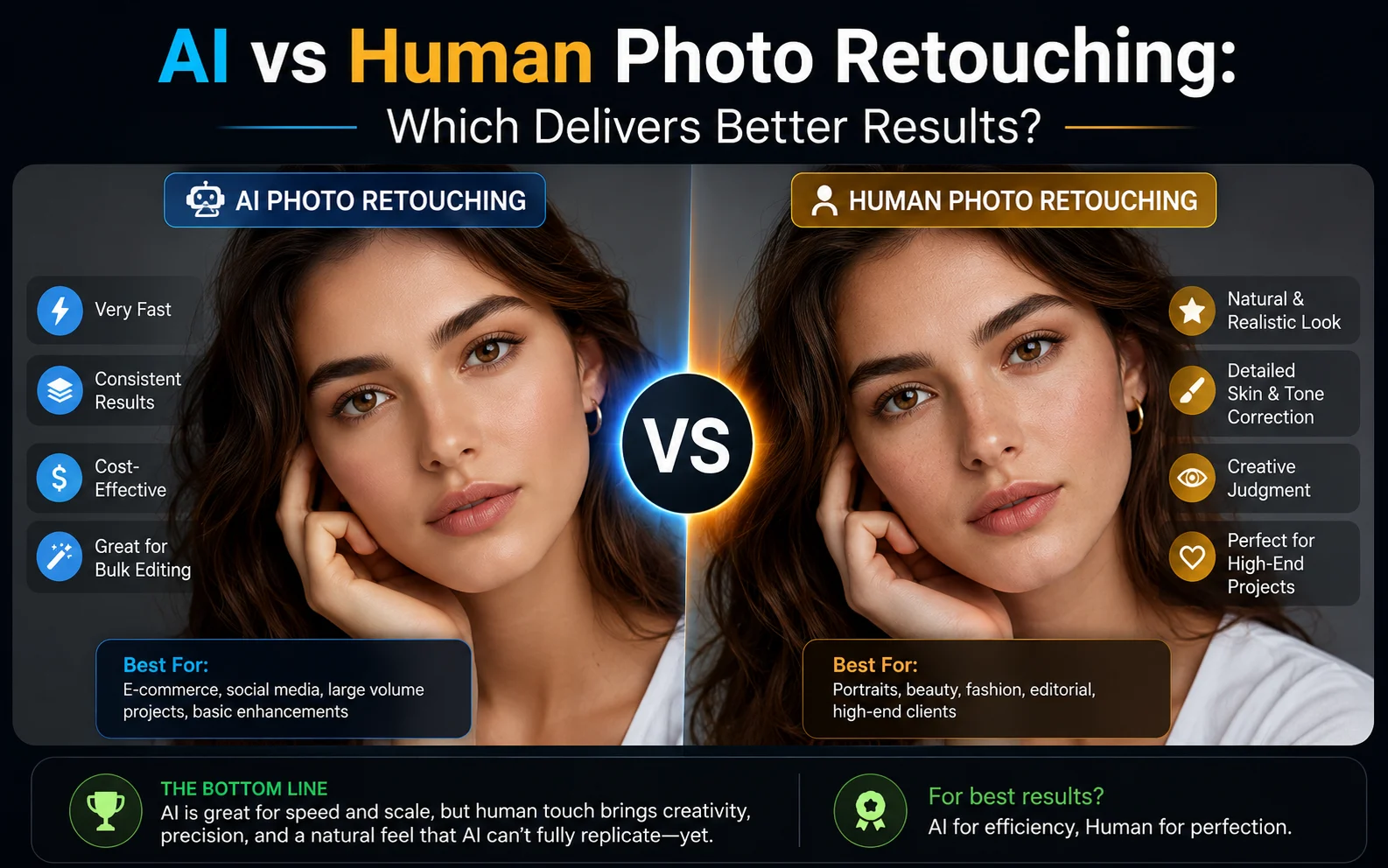
Human editors bring something AI cannot replicate: creative judgment, emotional intelligence, and an eye for detail that goes beyond pattern recognition.
A skilled retoucher understands context. They know when a shadow adds depth, when skin smoothing goes too far and starts looking unnatural, and when color correction needs a subtle touch rather than an automated fix.
Professional photo retouching services delivered by human experts are especially valuable for:
- High-end fashion and beauty photography
- Luxury product catalogs where brand perception matters
- Editorial and advertising images with complex lighting
- Portrait photography requiring sensitive and natural skin retouching
- E-commerce images where accuracy and consistency are critical
Human editors also handle client feedback more flexibly. They understand nuance in revision requests and adjust accordingly, something AI tools still struggle with.
Speed and Cost: Where AI Has the Clear Edge
Let us be direct. If speed and cost are your top priorities, AI tools win comfortably.
AI retouching platforms can process hundreds or even thousands of images per hour at a fraction of the cost of human editing. For businesses running large e-commerce catalogs or social media content pipelines, this efficiency is hard to ignore.
According to McKinsey, AI can reduce operational costs by up to 30% in creative and production workflows. For image-heavy businesses, those savings add up quickly.
Quality and Creativity: Where Humans Still Lead
Speed is not everything. When image quality directly affects brand trust and purchasing decisions, human expertise delivers results that AI simply cannot match consistently.
Consider these scenarios where human retouching outperforms AI:
Complex background removal: AI often struggles with fine details like hair strands, transparent objects, or intricate product edges. Human editors handle these with precision.
Color accuracy for products: Especially in fashion and home decor, accurate color representation is critical. AI tools can shift tones unpredictably, leading to customer returns.
Skin retouching for portraits: Over-processed AI skin smoothing often looks plastic and unnatural. A skilled human retoucher preserves texture and personality while still enhancing the image.
Brand consistency across campaigns: Human editors understand brand guidelines and apply them consistently across an entire image set in a way that feels cohesive and intentional.
The Hybrid Approach: Getting the Best of Both
Here is the truth that most service providers will not tell you. The best results often come from combining both methods.
Many leading studios and agencies now use AI to handle the initial bulk processing, such as background removal, basic color correction, and resizing, and then apply human expertise for final quality control, detail retouching, and brand-specific adjustments.
This hybrid model delivers speed without sacrificing quality. It is becoming the new standard for smart, scalable image production.
Which Option Is Right for You?
The answer depends on what your images need to accomplish.
Choose AI retouching tools if you need:
- Fast turnaround on large batches of standard images
- Budget-friendly editing for social media or internal use
- Simple background removal or basic color fixes
Choose professional human photo retouching if you need:
- Premium quality for advertising, fashion, or luxury brands
- Accurate product colors and fine detail work
- Consistent, brand-aligned results across a full catalog
- Natural and realistic portrait retouching
For most growing businesses, a combination of both delivers the strongest outcome.
Final Thoughts
AI is changing photo retouching fast, and that is genuinely exciting. But technology alone cannot replace the human eye for quality, creativity, and brand sensitivity. Whether you choose an automated solution or professional retouching expertise, always let your image goals lead the decision. Great photos build trust, and trust drives sales.